Dreamweaver opens in Murano

Imagine you have ten seconds to shout your dreams into a glass microphone. Easy? Maybe, but when the moment arrives, the words get stuck in your throat.

The Dreamweaver piece, which debuted in Murano, captures visitors’ dreams through AI. These dreams are reflected through a two-meter-tall unicorn panel. The glass unicorn fragments light into the room: red light on one side and blue on the other side of the darkened space. The reflection of the dream is not clear. It requires a true gaze to be seen.
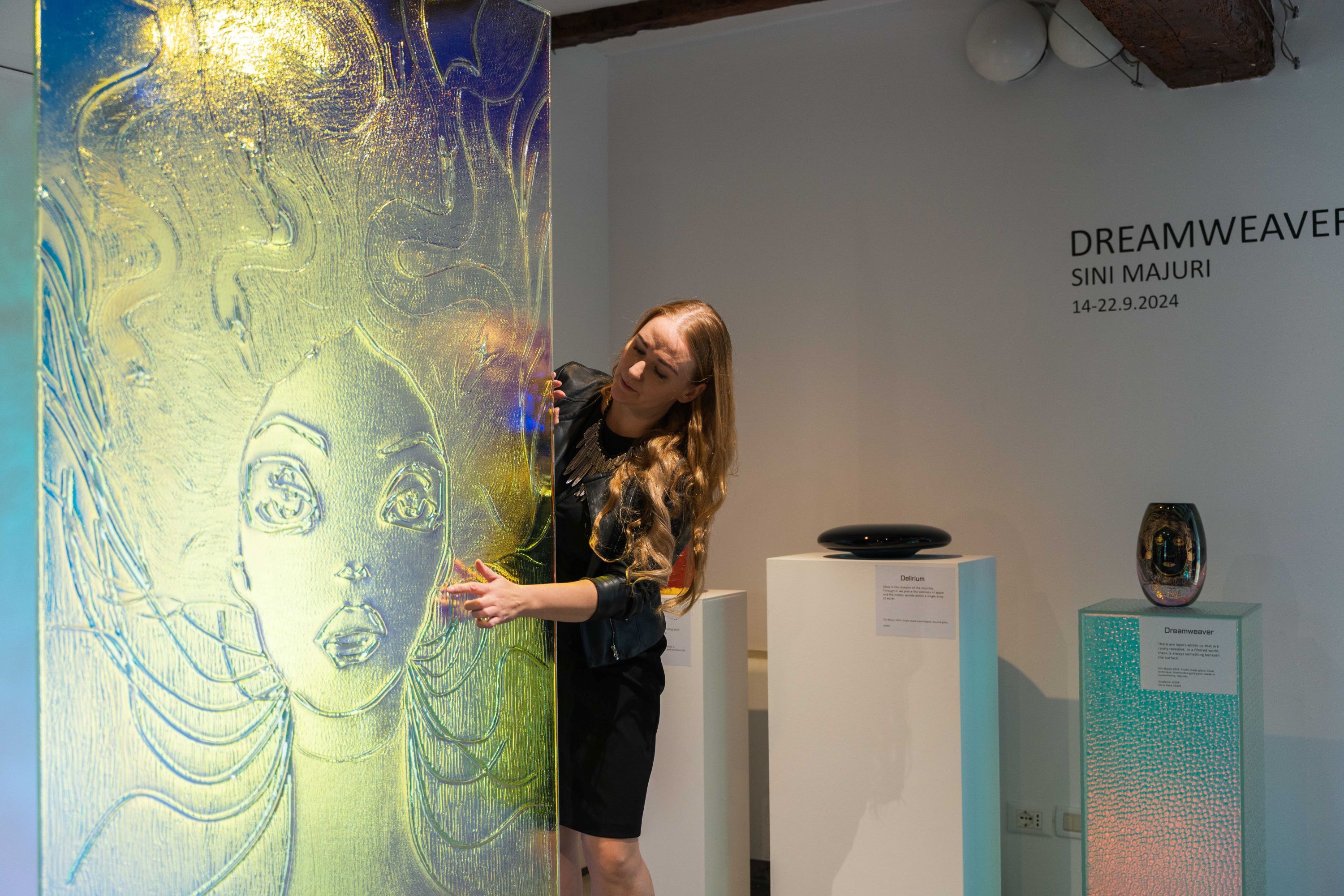
The large glass pieces The Lady and Echo were created in Kuopio at the Essis by Lasilinkki studio. Multidisciplinary collaboration is an essential part of the works. Photo: Juhamatti Vahdersalo.

The glass unicorn acts like a large surface filtering reality. The more we try to look, the harder it becomes. This time, filled with information and noise, suffocates us—when do we actually have time to dream? There is more to the world than just surface-level observation; it requires feeling.

Glass has always been a revealer of the invisible. A material that opens our eyes to both microscopic worlds in raindrops and to the universe beyond the stars. As a medium of art, it allows for an immaterial approach. The skill of glass is learned through touch. It reminds us that in art, as in life, the deepest meaning often arises from what we cannot see.

The Dreamweaver piece was exhibited in Murano at the SpazioB exhibition space. Photo: Juhamatti Vahdersalo.

In the white room stands The Lady, which changes color depending on the viewer’s angle. As we walk around her, she doesn’t change—only our perspective shifts. It’s rare to challenge our own prejudices and see others as separate from ourselves. At the same time, the piece invites touch. The two-meter surface is filled with grooves and shapes.

The works explore the relationship between humanity and technology, existing at the boundary between the visible and the invisible. Glass has always been one of the key technologies revealing the unseen, but what is our responsibility in this time when artificial intelligence is already part of everyday life? Who curates our dreams, and who truly owns them? And what about the future: do we have the right to the privacy of our dreams?

The AI-generated video piece reflected through the glass unicorn fragmented into the surrounding space. The technical implementation of the piece, including the AI aspects, was handled by Jarkko Takala, Tung Bui, and Ken Burridge. Photo: Juhamatti Vahdersalo.

Thank you our amazin partners for all the support:

Berengo Studio, Aalto Yliopisto, Essis by Lasilinkki, Kultaus Oy Snellman, The Venice Glass Week, Skyline Legal

AI & Glass: Unveiling Societal Stereotypes

If a glassblowing time traveller from the medieval era were to materialise in the Suomenlinna Glass Studio, they would likely navigate the workshop effortlessly. Hand tools and even the blowing bench have endured relatively unchanged. However, if the time traveller were a future AI cyborg, it would bring a whole new dynamic to the studio! In the world of artificial intelligence, there’s a noticeable gap in understanding traditional crafts. For instance, when it comes to glassblowing, the AI seems to mix up the tools with those used by electricians and blacksmiths. While these features are still evolving in visual AI applications, they intriguingly reflect aspects of our society – sometimes brutally honestly, especially when it comes to stereotypes.

tekoälytaide tekoäly ai glass art contemporary glass taide taiteilija veistos
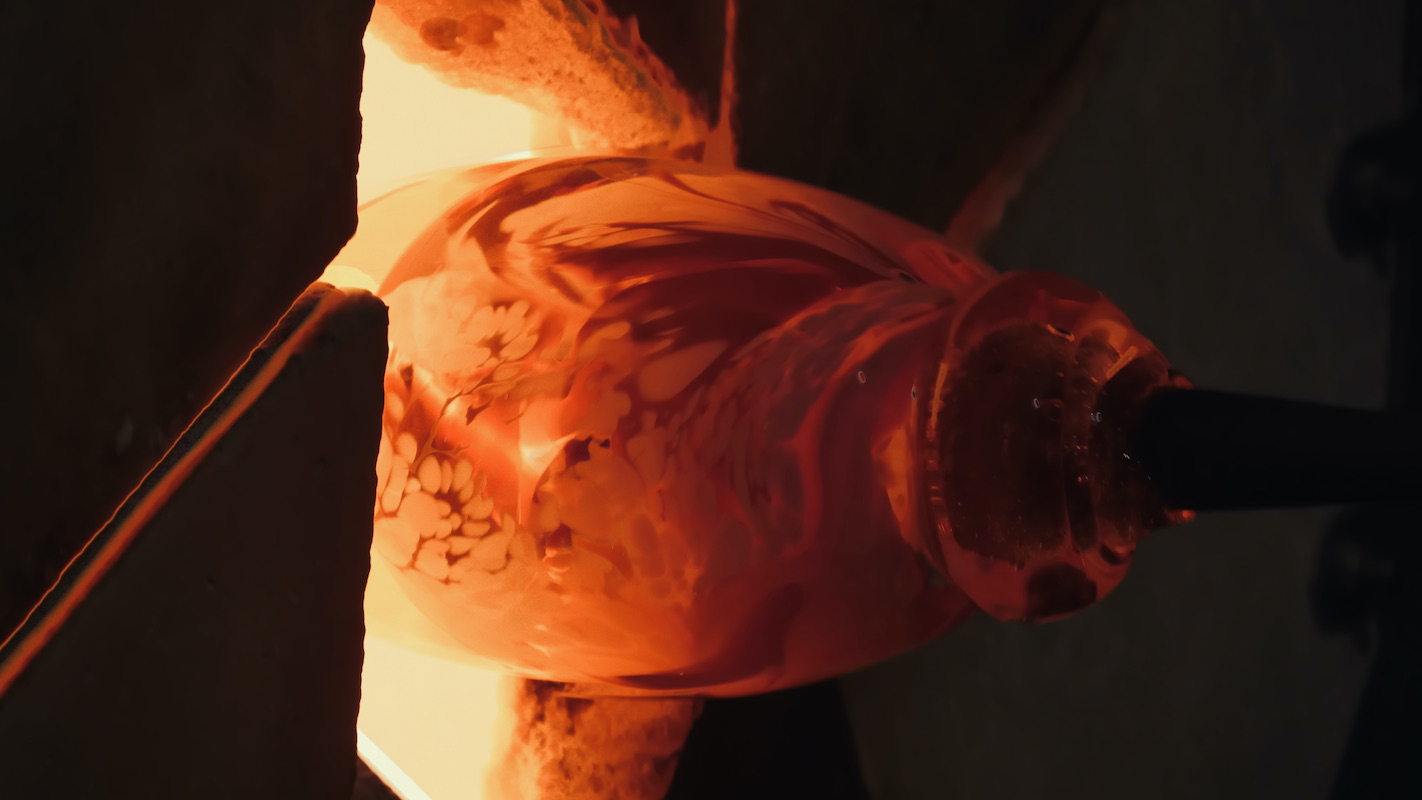
AI does not yet comprehend glassblowing, or at least it holds a highly futuristic perception of it.
Sin appears in the eyes of artificial intelligence as a characteristic linked to women. My assumption is that software like MidJourney relies heavily on imagery from popular culture, further reinforcing connections to human traits and characteristics. This trend is increasingly shaping associations with various aspects of personalities and features

The questions arise: What do researchers from Finland, Sweden, or Norway look like? How about a New York street cleaner? The pursuit of these answers embarks on a journey I undertake in December with the support of the Kordelin Foundation. It’s a great opportunity to start an art project that blends glass and artificial intelligence. My intention is to capture stereotypes in the early stages of visual artificial intelligence programs. Technology is a mirror reflecting the complexity of humanity. Visual AI applications mirror societal assumptions about social classes and backgrounds. Image recognition, for instance, can paint a picture that people in certain environments or wearing specific types of clothing belong to a particular social class.

I filter this data through the ancient techniques of mouth-blown glass. It offers a unique opportunity to scrutinise stereotypes through the intangible medium and see into the intersection of technology and art. Can technology operate as the medium of art and what is its potential to challenge, transform, or reinforce our perspectives on the world? The synergy of ancient glassblowing and modern AI creates a space where contemporary stereotypes can be critically approached through art.

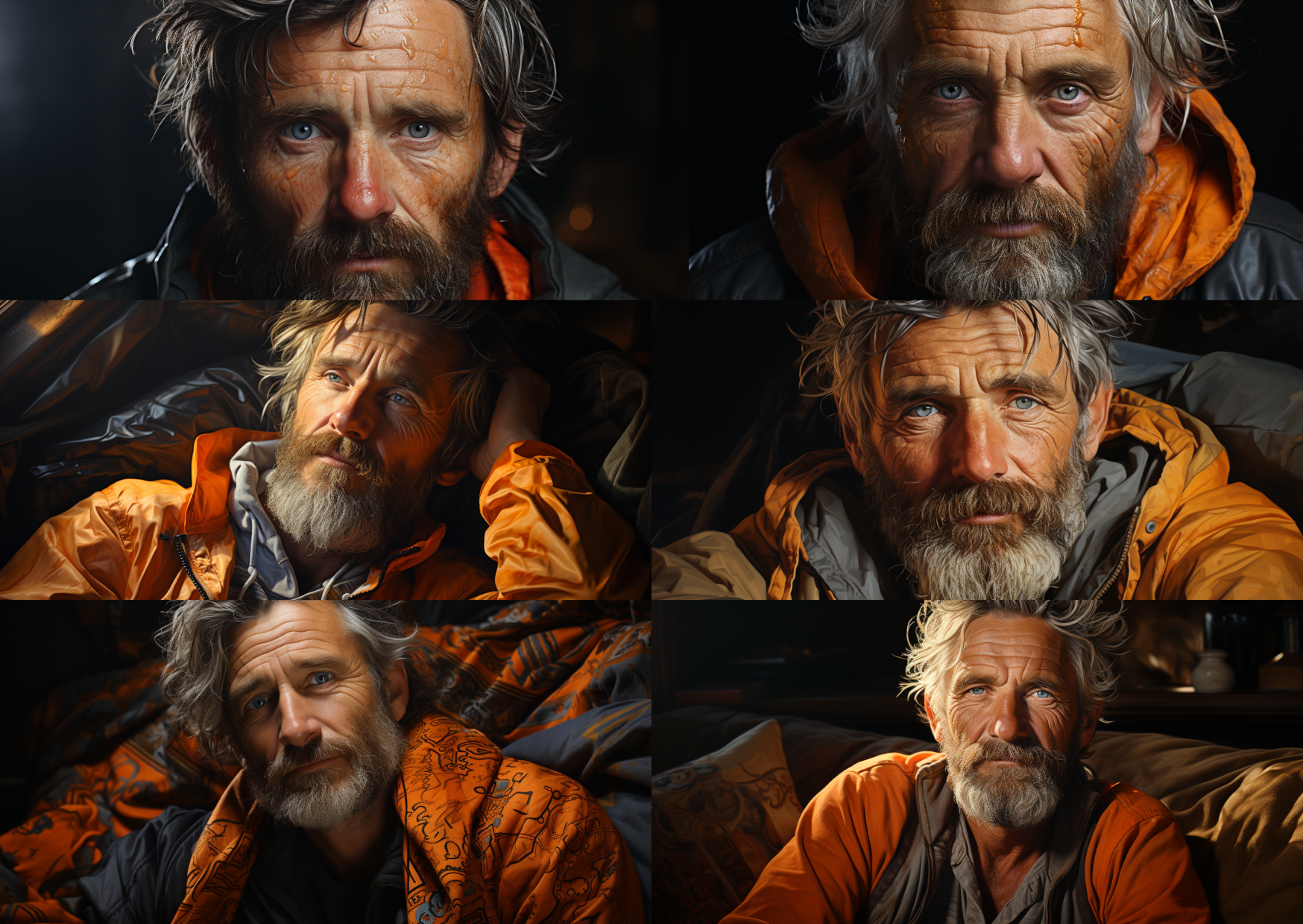
What does a liar look like? Well, as a bearded man in a hoodie? Lying, deceit and evil people are the characteristics connected to this orange hooded archetype. The recurring appearance may stem from both the training data used and the algorithm’s generalising nature in response to specific search commands
tekoäly ai artificial intelligence taide contemporary glass contemporary art taiteilija taideteos
In the eyes of artificial intelligence: a New York City street sweeper. I am interested in how nascent AI applications reflect societal stereotypes. Generalisaitons related to professions and gender are widely acknowledged issues, and it’s certain that they will evolve rapidly in the coming year. In the artistic process, I also pay attention to this change.
In depictions of mental illnesses, such as schizophrenia, generated by artificial intelligence, recurring patterns include faces that predominantly represent men – who look like they’ve been snipped straight out of Netflix . In image generations, for instance, the phrase ‘evil person’ primarily produces images of older men.

I’m interested in introducing more people to the fascinating world of glass and keeping it accessible. I’m part of a multinational project pushing to get glass recognised on UNESCO’s prestigious list. But let’s face it, having a fancy status isn’t enough; we need to take real action and spark fresh interest in glass art. The craft is fading fast worldwide. As the glass experts exit the scene, their endangered know-how is quietly slipping away. My ambition is to act as a catalyst, pushing the industry forward through inventive collaboration

As we stand at the crossroads of time, where the medieval craftsmen and the futuristic AI cyborg converge in the glass studio, it becomes apparent that the journey undertaken is not just through the lens of art and technology – it is a narrative that mirrors the complexities of our evolving world.

Thank you Kordelin foundation for the support! #kordelininsäätiö #kordelininsäätiöntuella

Flow collection brings 3D perspective into abstract brush strokes

The Flow edition gains inspiration from the elegance of the movement of liquid glass that is frozen into a stasis that is fragile yet forever. The rhythm of the glass making process ensures that every vessel has unique splashes of color that mimic the dance of brush strokes of abstract impression. Every vase has their own breath. It’s a methaphor for a soul of a piece that makes it more than mere interior object. Flow is a 3th edition of Sini Majuri’s Jungle series that has been awarded with a Golden and Silver A’Design Award.

The Flow is a 3th edition of Sini Majuri’s Jungle Collection. Every vase has it’s own color play inside a thick glass.
Every vessel is studio made in Finland and shaped by hand.

Flow collection mixes Scandinavian cool with capricious Finnish glass blowing techniques that allow color flow freely within the glass layers. Collection has three shapes and the design is available in green, blue and purple. Studio made vases are signed by hand and numbered.

A simplified shape can become multi-dimensional in glass medium; There is the visual layer of glass: how does the glass reflect, how will the colors look in different light. Above all there are also the historical layers of glass, the origin of Finnish glass making and the rare knowledge behind the craftsmanship.

Inquiries of the Flow Collection via email. Manufacturing time of orders with more than 10 objects is 2 weeks. For international orders, please ask for a quote with shipping fee.

Flow Collection is made in wide (20 cm tall), small (9 cm tall) and tall (23 cm tall) shape.
Every piece is an unique artwork.
The process of the Flow Collection ensures that every vase has a unique color play inside the hand shaped glass. Made in Mafka&Alakoski studio, Riihimäki, Finland.